Somewhere on your feed right now, a person who does not exist is selling something to people who do. She has a name, a personality, brand deals, and an engagement rate most human creators would kill for. She is an AI influencer — and the accounts behind characters like her are one of the fastest-growing categories in short-form content.
This guide covers what AI influencers actually are, why they perform, and the full workflow for creating one of your own: designing the character, keeping the face consistent across every image, and turning it into video with Motion Control.
What is an AI influencer?
An AI influencer (or virtual influencer) is a computer-generated character that operates a social media presence the way a human creator would: a recognizable face, a defined personality, a consistent aesthetic, and a steady stream of posts. The audience often knows the character isn't real — and follows anyway, the same way people follow animated characters, VTubers, or comic strips.
The key word is character, not image. One AI-generated portrait is a picture; a face that shows up every day with new outfits, new locations, and new opinions is an influencer.
The AI influencers that proved the model
These accounts turned virtual characters into real businesses:
| Influencer | What they are | |
|---|---|---|
| Lu do Magalu | @magazineluiza | Brazilian retail icon, the most-followed virtual influencer in the world (~8M+ followers) |
| Lil Miquela | @lilmiquela | The original virtual it-girl (2016), ~2M+ followers, deals with Prada, Calvin Klein, and Samsung |
| Aitana López | @fit_aitana | Hyper-realistic Spanish AI model reportedly earning thousands of euros a month from brand work |
| Shudu | @shudu.gram | The world's first digital supermodel, shot for high-fashion campaigns |
| Imma | @imma.gram | Japanese virtual model with a signature pink bob, campaigns with IKEA and Porsche |
| Noonoouri | @noonoouri | Stylized fashion avatar signed to a real modeling agency and a record label |
Two things stand out. First, the range: hyper-realistic (Aitana), clearly stylized (Noonoouri), and everything between — realism is a choice, not a requirement. Second, the economics: industry analyses have found virtual influencer posts earning engagement rates well above comparable human accounts, because the content is unusual, visually polished, and posted with inhuman consistency.
Why AI influencers are part of the brainrot ecosystem
Brainrot content isn't one format — it's a content philosophy: fast, attention-grabbing, trend-driven, endlessly repeatable. Reddit stories, fake texting dramas, Minecraft parkour narration — and now virtual characters. AI influencers slot straight into that ecosystem:
- They're trend machines. A virtual character can jump on a trending dance or meme format within hours, because there's no shoot to schedule.
- They compound. Every post builds recognition for the same face, the same way a recurring meme character builds equity.
- They're weird in a good way. An impossibly perfect model — or a crocodile in a suit reviewing gas station snacks — both trigger the "wait, what?" response that stops thumbs.
The same platform mechanics that reward a Reddit story video or a brainrot explainer reward a character account that posts daily. The clearest current example is the AI looksmaxxing influencer trend, where generated "perfect faces" front one of the highest-engagement genres on the feed.
How AI influencers are created
Every serious AI influencer workflow has to solve the same three problems.
1. Designing the character
You need deliberate decisions about who this character is: face, body, age, style, and the rendering aesthetic (photoreal? anime? 3D?). Prompt-only tools make this frustrating — a paragraph of text produces a different interpretation every run.
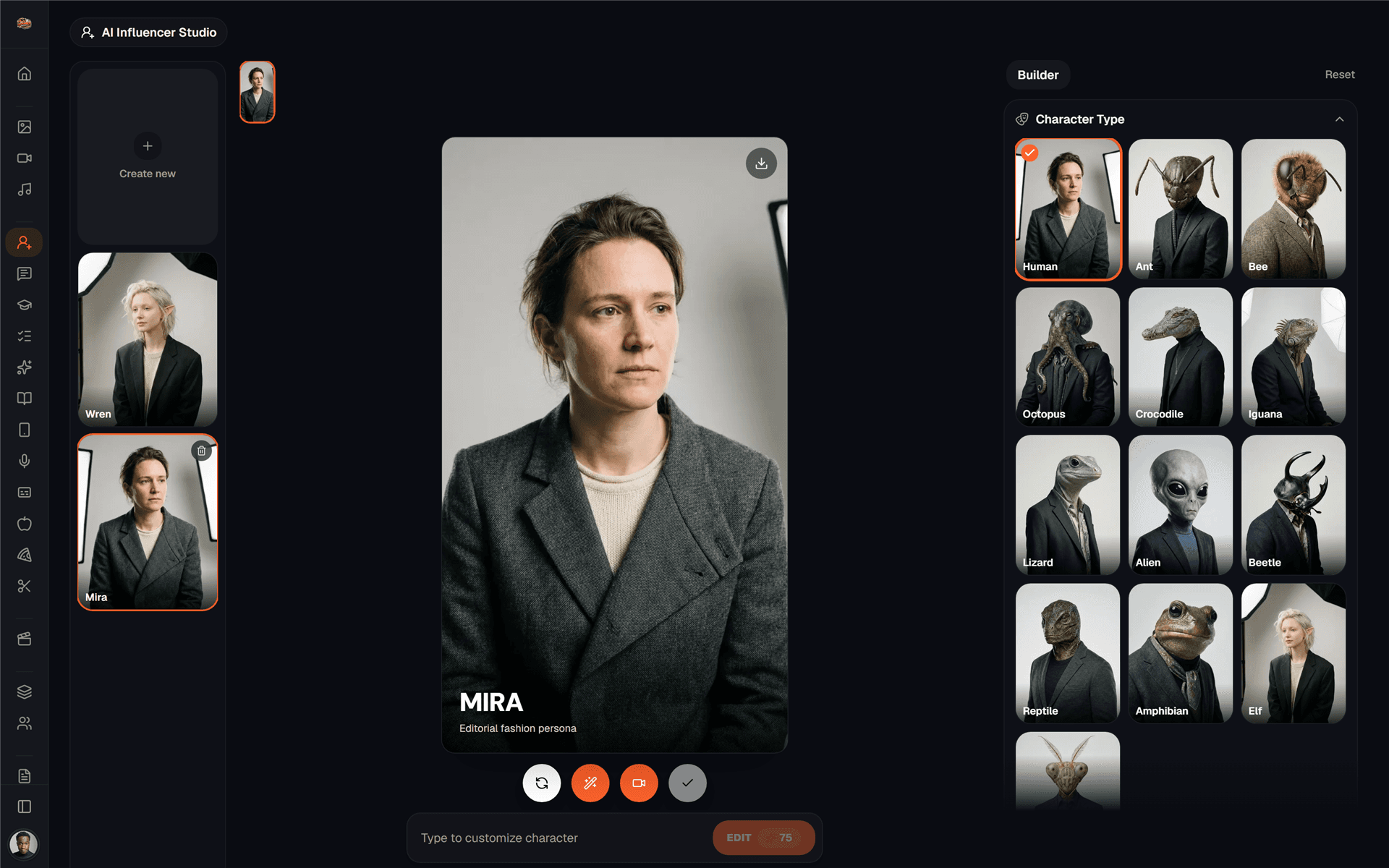
The AI Influencer Studio replaces prompt roulette with a character sheet: 13 character types (human, elf, alien, crocodile, octopus, bee, and more) and 22 structured controls covering ethnicity, age, skin tone, eye color, facial features, body type, individual limbs, hair, accessories, and four rendering styles. The design is saved as structured identity data, not a prompt you have to reproduce.
2. Keeping the face consistent
This is the moat. If your character's face drifts between posts, you don't have an influencer — you have a moodboard. Audiences (and the algorithm) build recognition around a stable identity.
Because the studio stores your character's design as data, every new generation starts from the same identity. You change the scene, not the character: type "streetwear, Tokyo crosswalk at night" or "red carpet gown, golden hour" into the customize bar, and the same face shows up dressed for the occasion. Generate, save the winners, and the character's library becomes your content calendar.
3. Making it move
Static posts cap out fast. Short-form video is where character accounts actually grow — and that requires animation.
Motion Control (powered by Kling v2.6) takes any portrait of your character plus a reference video, and outputs a new video of your character performing the exact movements: dances, gestures, walking shots, reactions, facial expressions. Trending choreography on TikTok? Upload the reference, pick your character's portrait, generate. You can keep the reference audio for dance and lip-sync formats or swap in your own voiceover.
That's the full loop: design the character → lock the identity → generate scenes → animate with Motion Control → post the short.
A realistic content strategy for a new AI influencer
- Define the niche before the face. "AI model" is not a niche. Gym aesthetics, thrift-fashion hauls, deadpan product reviews, travel fantasy — pick the content genre first, then design a character that fits it.
- Batch a visual identity. Generate 15–20 images of your character across outfits and settings before posting anything. You want a feed that looks established on day one.
- Lead with video. Post the Motion Control clips as Reels/TikToks and use stills as supporting posts. Video is what the recommendation algorithms actually push.
- Ride references, not ideas. The fastest content system is: find a trending clip → reproduce its motion with your character → publish while the trend is alive.
- Stay consistent for 30 days. Character accounts compound slowly, then suddenly. The accounts that win are the ones still posting in week four.
FAQ-style quick answers
Is it legal to run an AI influencer account? Yes — virtual influencers are an established industry. Platforms increasingly expect AI-generated content to be labeled as such, so use the AI-content disclosure toggles where they exist.
Do AI influencers make money? The proven routes are brand partnerships, affiliate content, audience-building for a product you own, and platform creator programs. Aitana López's creators have said she earns thousands of euros in a good month.
Do I need design skills? No. The studio's builder is click-to-select, and the randomize button will invent a character you can refine with plain text edits.
What's the difference between an AI influencer and an AI avatar? An influencer is a standalone persona with its own audience; an avatar represents you or your brand. Same technology, different job — the AI avatar guide covers the other side.
Create yours
The tooling that used to require a small studio — character design, identity-locked generation, motion transfer — now lives in one place. Design a character in the AI Influencer Generator, generate its first portraits free, and give the algorithm a new face to remember.